Centuries of a rich cultural heritage have shaped India on its path to becoming a global powerhouse. Over the millennia, the country’s foundations as an ancient civilization in the Fertile Crescent gave rise to its status today as a leading technological and industrial innovator.
With a diverse population, globally recognized landmarks, and some of the world’s tastiest cuisine, you’ll find plenty of reasons to explore everything this country has to offer. Here are some fascinating facts about India that you may not know.
Key takeaways
- India is known for its long and storied history, ancient cultures, diverse demographics, and numerous languages.
- Today, India is home to a skyrocketing economy as well as the largest democracy and is a world leader in tech.
- With Western Union, you can send money to India in just a few clicks, either directly to a bank account for friends and family or as cash pickup at a Western Union location.
1. A vast and varied land
India is the seventh largest country in the world, forming the bulk of the Indian subcontinent and bordering six countries: Bangladesh, Bhutan, China, Myanmar, Nepal, and Pakistan. About a third of India’s borders are coastline, as the country is a peninsula that fronts the Arabian Sea, the Bay of Bengal, and the Indian Ocean.
2. Diverse demographics
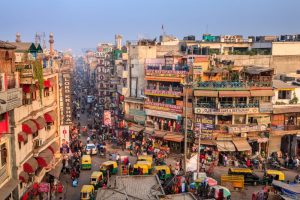
The most populous country in the world, with nearly 1.5 billion residents, India is incredibly diverse, with thousands of ethnic and tribal groups. The country’s location and its history of occupation by various outsider groups means that its people share ethnic similarities with Arabs, Afghans, Mongols, Persians, Scythians, and Turks.
Most of the country — about 80% — practices Hinduism, with Islam, Christianity and Sikhism attracting other worshippers.
3. A chorus of dialects
If you plan on moving to India, you’ll want to learn the language. The question is, which one?
Perhaps one of the most surprising facts about India is that its people speak over 1,500 languages, 122 of which are officially recognized as of the country’s latest census. However, India’s lingua franca, the uniting language spoken across much of the country, is Hindi, with Bengali coming in second.
English is another language spoken widely, a reminder of the country’s century of British colonial rule. Because India is so densely populated, it’s actually one of the largest English-speaking countries in the world.
4. Birthplace of major faiths
Another interesting fact about India: Parts of Hinduism, the country’s most popular religion, were born in India more than three thousand years ago, making it the oldest religion on Earth. Adherents believe in karma and reincarnation.
India is also the birthplace of other major religions that have shaped global culture and philosophies. Buddhism, for example, began about 2,500 years ago, the brainchild of an Indian prince named Siddartha Gautama. Buddhists believe in the cycle of life, death, and rebirth, and that it’s possible to escape this cycle through enlightenment.
Jainism was also founded in India at least 500 years before the common era; one of its main principles is a belief in nonviolence. And Sikhism, the world’s fifth largest religion, was born in India 500 years ago. Its believers promote the idea of equality among all people.
5. A calendar full of celebrations

It seems there is always something worth celebrating in India. The country observes countless holidays that bring families together and highlight its diversity.
One of the biggest holidays of the year is Diwali, the festival of lights. During Diwali, which lasts five days, people clean their homes, light clay lamps, and enjoy feasts and fireworks. Eid, or Eid al-Fitr, is a joyful celebration marking the end of Ramadan, a month of fasting and devotion for Muslim worshippers. Holi is a holiday celebrating the arrival of spring, marked by a riot of color and a variety of sweet treats.
6. Flavors that travel the globe
Another fun fact about India: It is the world’s largest spice producer, cultivating 60 of the 109 spices recognized by the International Organization for Standardization (ISO).
Spices add punch to Indian dishes like biryani, aloo gobi and panak paneer as well as masala chai, the tea drink spiced with cardamom, and curry, a colonial term for a variety of saucy, spiced meals. Many Indian dishes are also vegetarian; 81% of adults in India limit meat in some fashion.
7. Ancient roots and discoveries
India’s Bronze-age Indus civilization is among the world’s oldest and most extensive urban cultures. It arose around the same time as ancient Egyptian and Mesopotamia civilizations, and its residents harnessed the Indus River to take advantage of the fertile river valley for farming.
India was also the birthplace of nothing — that is, the concept of zero. The first recorded use of the concept was discovered in a text dating to around the third or fourth century, while the round numeral we know today didn’t arrive in Europe until the thirteenth century.
8. Icons of heritage and wonder
India is home to dozens of globally significant landmarks. The Taj Mahal is a white marble mausoleum, completed in 1648 and dedicated to then-emperor Shah Jahan’s beloved wife, Mumtaz Mahal. Other UNESCO-protected sites (there are 44) include Humayun’s Tomb in Delhi, the Ellora Caves, and old-town Jaipur, also called the Pink City.
Two more interesting facts about India: It is home to both the world’s largest sundial and the world’s highest rail bridge.
9. Modern India: Technology, cricket, and more

Today, India is home to the world’s largest democracy, the world’s largest diaspora, and the world’s largest film industry. Its economy is the world’s fifth largest and the fastest-growing, and India’s growing middle class is poised to make up more than 60% of its population by 2047. Its currency, the rupee, is one of the world’s oldest. Use our USD to INR converter to the see exchange rate of dollars to rupees.
India leads the world in technological innovation and digital adoption, including AI adoption. It has a huge talent pool and its government strongly supports digital infrastructure and manufacturing.
When its residents aren’t working, they’re likely watching cricket, the country’s biggest sport by far. An estimated 90% of the world’s cricket fans reside on the Indian subcontinent, and cricket makes up 85% of the country’s spending on sports.
10. Surprises about India
With such a rich cultural heritage and huge land mass (India is the seventh largest country in the world), there’s no end of fun facts about India to discover.
It’s home to three of the largest urban centers (Mumbai, Kolkata, and Delhi) and the world’s largest postal network. It’s where shampoo, yoga, chess, and algebra were invented. India is also home to one of the oldest continuously inhabited cities, a lake filled with skeletons, and a place where cars roll uphill (or at least appear to).
India produces the most milk, the most tigers, and the most vegetarians. The Indian city of Mawsynram produces the most rain, with an average annual rainfall at 467 inches. And India hosts the largest gathering in the world: the Maha Kumbh Mela, a festival of faith.
Send money to India with Western Union
With its unique blend of ancient history and modern technology, India’s global importance is clear, and its influence is widespread. India’s culture and connections link families together, even across borders. Global money transfer networks like Western Union support those treasured links, offering safe and reliable ways to send money home or abroad.
Whether you or your loved ones call India home, or you simply enjoy visiting its multitude of wonders, managing your money in and out of India doesn’t have to be complicated. Use the Western Union mobile app to send money quickly or stop by an agent location to get started.
FAQs
India is famous for so many things, from yoga to chicken tikka masala to the Taj Mahal, and thousands more.
India’s residents speak more than 1,500 languages, from the widespread use of Hindi and English to hundreds of unique local dialects. The country’s national census recognizes more than 100 languages.
India’s currency is called the rupee, and it is issued by the Reserve Bank of India. The digital rupee is the country’s official digital currency and is also issued by the Reserve Bank of India. Compare the value of a rupee to a US dollar using a currency converter to see the latest rates.
Many expats find the job opportunities, culture, and cost of living in India to be very attractive reasons to put down new roots. Many American expats have chosen to live in Delhi, but extreme pollution and safety concerns may give some pause.



