If you are a foreign citizen and wish to stay more than three months in France, you must have a long-stay visa. Mandatory depending on your nationality and your reason for stay, this document, called a D visa, authorizes you to stay 4 to 12 months on French territory and offers you many rights.
To make sure you get the right long-term visa for France, we explain everything about the visa type D and how to succeed: which long-stay visa to choose, where and when to apply, what documents to send, what fees to pay, etc.
What is the long-stay visa in France?
The long-stay visa, called visa type D, is a document issued by the French administration for any stay of more than 90 days on the territory. It allows you to enter and stay in France for a period of 4 months to 1 year, for personal or professional reasons.
This visa also allows you to move freely throughout the Schengen Area, limited to a maximum of 90 days in any 180-day period. The visa type D concerns all foreign nationals of legal age who wish to stay in France for more than three months, even those exempt from a short-stay visa.
Who is exempt from a long-stay visa in France?
Some foreign nationals are exempt from applying for a long-stay visa for France: citizens of the European Union, citizens of Iceland, Switzerland, Norway and Liechtenstein, as well as citizens of Andorra, Monaco, San Marino and the Vatican.
Certain categories of foreigners are also exempt from the visa type D:
- ICT (Intra-Corporate Transfer) employees who wish to assert a right to intra-European mobility.
- Third-country nationals holding an “EU long-term resident” residence permit.
- Citizens of a third country who have a short-stay visa bearing the mention “Famille de français”.
- Foreign students who have followed an uninterrupted schooling in France since the age of 16 and who are continuing their studies there.
- Foreign citizens residing in an EU Member State posted to France.
In the latter two cases, foreign nationals must still apply for a residence permit once in France.
What are the different types of long-stay visa?
There are several types of long-stay visas for France:
- The VLS-TS visa
- The visa mentioning “residence permit to be applied for within 2 months of arrival”
- Working Holiday Visa (WVV)
- The minor visa for schooled in France
- The temporary long-stay visa
The sort of visa type D issued depends on the intended length of stay and the reason for your stay: professional activity, studies, internship or training, or tourist, family or private visit. The most well-known visa is the VLS-TS.
The VLS-TS, long-stay visa equivalent to a residence permit
This visa, known as VLS-TS, is valid for 4 to 12 months and is equivalent to a residence permit. This means that it allows you to reside on French territory for the entire period and that it exempts you from applying for a residence permit when you arrive in France. It also allows you to carry out a professional activity.
The VLS-TS concerns in particular:
- Students
- The trainees
- Employees with a fixed-term or permanent contract
- Spouses of French citizens. In this case, the visa is issued without conditions but may be refused if the marriage is fraudulent or annulled, or if the applicant poses a threat to public order
- Holders of a Talents residence permit (qualified employees, medical professionals in the pharmaceutical industry, researchers, artists, nationally or internationally renowned people, etc.)
If you obtain a VLS-TS visa, you must validate it within three months of your arrival in France and pay a fee in addition to the visa fee. This procedure is carried out online on the Public Service website.
The visa mentioning “residence permit to be applied for within 2 months of arrival”
This long-stay visa allows you to enter France and obtain a residence permit (annual, multi-year or 10-year), as long as you apply at the prefecture within two months of your arrival in the country.
In particular, the following are issued:
- Families of French nationals (child aged 16 to 21 or dependent of a French national, dependent ascendant of a French citizen and his or her spouse)
- Foreigners exercising a liberal or self-employed profession (trader, craftsman, etc.)
- Workers (employees on assignment, EU Blue Card, seasonal, talent) or families of workers
- Pensioners or spouses of pensioners
- To the artists
Working Holiday Visa
This long-stay visa is only accessible if your home country has a bilateral “working holiday” agreement or if you are a Taiwanese citizen. If you are between 18 and 30 years old (35 years old for Australia, Argentina and Canada), this visa allows you to stay and work in France for up to one year.
Note that the Working Holiday visa type D does not require you to have found a job before leaving for France.
The minor visa enrolled in France
This long-stay visa, valid for a maximum of 11 months, is issued to young people under the age of 18 whose parents live abroad, and who are attending school or studying in France for more than three months.
Once issued, this long-term visa allows unlimited entry into France during its validity period, without having to apply for a new visa, and exempts you from applying for a residence permit.
The temporary long-stay visa
This long-stay visa, valid for 4 to 6 months, allows you to stay temporarily in France, if you are following a short education, have an artistic activity, or come as a visitor. In the latter case, you must be able to live on your own resources.
This type D visa does not allow you to work, does not exempt you from applying for a residence permit at the prefecture, and is not renewable.
Send money abroad with Western Union
With Western Union, you can send money abroad in just a few clicks. Millions of customers trust our reliable service.
When do I apply for a long-stay visa?
The application for a long-stay visa must be made no earlier than 3 months before the date of your planned departure for France, regardless of the reason for your stay (visitor, spouse, professional, student, etc.).
Where can I apply for a long-stay visa?
The application for a long-stay visa for France must be made at the French embassy, the consulate of France, or the external service provider (VFS Global, TLS, etc.) of the state of your habitual residence.
How do I get a long-stay visa?
All applications for a long-stay visa are made automatically on the official France-Visas website. You then need to follow several steps: checking the need for a visa and the application requirements, filling out the application form, going to the visa centre, paying the fee, tracking the application, retrieving the passport.
Step 1: Check if, depending on your situation, you need a visa type D to enter and stay in France.
Step 2: Check if you meet the visa application requirements: justified reason for application, sufficient means of subsistence for the entire duration of the stay, subscription to health insurance covering any potential medical expenses, not being subject to an inadmissibility.
Step 3: Complete the long-stay visa application form, attaching the required documents.
Step 4: on France-Visas, make an appointment at the authorized visa centre (embassy, consular services, service providers) in your country of residence. Remember to find out about the appointment times to obtain your type D visa with enough advance. The site recommends getting an appointment between 6 months and 15 days before your departure.
Step 5: At the appointment, submit your complete application and pay the application fee. At this stage, the authorised service collects your biometric data (photo and fingerprints), verifies the authenticity of your documents and keeps your passport and supporting documents, to transmit them to the consulate. This in-person appointment, which allows you to assess the coherence of your plan to stay in France, is mandatory for all first-time applicants for a long-term visa of more than 12 years.
Step 6: Wait for the notification inviting you to go to the visa centre where you submitted your application, to pick up your passport containing your visa type D sticker. Depending on your country of residence, the passport can be sent to you by post.
Step 7: if you have obtained a VLS-TS, you must validate it online within three months of your arrival in France.
What documents do I need to provide for a long-stay visa in France?
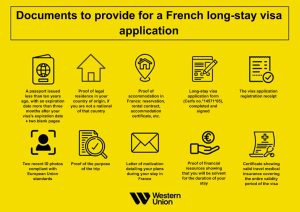
When applying for a long-stay visa in France, you must provide several mandatory documents that vary according to your situation and the reason for your stay. The necessary supporting documents, original and copies, are indicated on the receipt of registration of the visa application.
As an indication, for a VLS-TS visa, you must present:
- Passport less than 10 years old, expiring more than 3 months after the end date of your D visa, and with 2 blank pages.
- 2 recent passport photos that meet European Union standards.
- Proof of legal residence in the country of origin, if you are not a national.
- Long-stay visa application form (Cerfa n°14571*05) completed and signed.
- Receipt of registration of the visa application.
- Cover letter detailing your plan to stay in France.
- Proof of the purpose of the trip: employment contract, internship agreement, copy of your residence permit bearing the mention “student”, copy of the diploma obtained in the 4 years preceding the application, proof of a business creation project in a field corresponding to your training, etc.
- Proof of accommodation in France: reservation, rental contract, certificate of accommodation, etc.
- Proof of financial resources proving that you are solvent for the duration of your stay (originals of bank statements for the last 3 months or 3 payslips, proof of pension, etc.).
- Valid travel medical insurance certificate covering the entire period of validity of the visa type D.
These documents must be presented in French (originals and photocopies). If some documents are not in French, you must translate them before applying. If in doubt, consult the Visa Wizard to check the list of documents to be provided, depending on your situation. Please note that any incomplete application may result in a refusal to obtain a long-stay visa for France.
What is the price of a long-stay visa in France?
The price of a long-stay visa in France is generally €99. However, the amount may vary depending on the country of origin, the situation, and the reason for the foreign applicant’s stay. This visa type D fee is always to be paid in local currency and is not refunded in the event of a visa refusal.
For example, for a long-stay visa to France from Morocco, the fee to be paid is 1068 Moroccan dirhams. For a visa from Turkey, the fee is 4770 Turkish lira. Easily convert euros to your local currency with our Western Union currency converter.
Some nationals benefit from visa fee reductions through bilateral agreements with France. Similarly, some applicants are exempt from the visa type D fee, including:
- Spouses of French people
- Non-European family members of a European (other than French) or Swiss
- Seasonal workers
- French teachers
- Certain Working Holiday Visa Recipients
- Holders of a diplomatic or service passport
- Veterans with a free care booklet coming to France for medical treatment
Please note that VLS-TS holders will also have to pay an additional tax upon arrival in France, the amount of which varies according to the reason for stay:
- €200 for employees
- €50 for students
- €200 in the case of family reunification
How long does it take to process a long-stay visa in France?
The processing time for a long-stay visa for France generally varies between 15 and 60 days. This time depends on the time of year and the volume of files to be processed when the application is sent. Some urgent requests for professional or medical reasons can be processed within 10 working days, upon presentation of supporting documents.
Similarly, depending on the complexity of the file and the need to carry out additional verifications or obtain missing documents, the processing time may be longer or shorter. In particular, the delays in applying for long-term visas for family reunification can be very time-consuming, requiring a thorough check of the applicants’ family ties, housing conditions and financial resources.
To avoid additional delays and obtain your visa type D quickly, make sure to submit a complete and well-organized file and to prepare your appointment well.
What should I do if I refuse a VLS-TS or long-stay visa?
In the event of a refusal of a VLS-TS or long-stay visa, which must always be justified, you can file a non-contentious appeal with the French consulate or embassy in your place of residence and request a review of its decision.
A long-stay visa for France can be refused in several cases, including:
- If you have been subject to an obligation to leave French territory for less than 5 years and have not provided proof of having left French territory within the period granted, except in humanitarian circumstances.
- If you are a national of States that do not cooperate sufficiently in terms of readmission, unless you are the spouse of a French citizen.
- If you are subject to a ban on French territory: judicial or administrative ban, expulsion decision, return ban, travel ban.
How do I renew a long-stay visa?
To renew your long-stay visa, and particularly your VLS-TS, you must apply for a residence permit 4 to 2 months before the expiry of your visa. The renewal process is carried out exclusively on the ANEF platform, and costs around €225 for a first residence permit.
I checked several visas to see how the renewing processed worked. Here is an example, in the tab “renouvellement” and the section “Epoux de Français”.
The criteria for accepting the renewal of the visa type D, and for obtaining a residence permit, are based on several elements: regularity of your presence in France, stability of the situation, recent supporting documents (certificate of residence, bank statements, proof of professional activities or studies), etc.
Have you obtained your long-stay visa for France and are looking for the best way to send money to another country? Western Union offers you the fastest, most reliable way to send and receive money. Take advantage of the best rates on the market in more than 200 countries.
FAQs
The short-stay visa only allows a one-off stay of 90 days in France and in the European area. Unlike the long-stay visa, it does not allow long-term residence and does not give the right to practice a professional activity.
A long-stay visa is valid for 3 months to 12 months, depending on the type of visa type D obtained. For example, a VLS-TS allows you to stay up to one year in France, while a temporary long-stay visa allows you to stay a maximum of 6 months on French territory.
Yes, the long-stay visa for France allows you to work on French territory, without having to apply for a work permit. The visa type D granted can vary your situation: employee, self-employed, entrepreneur, artist, etc.
If you arrive in France with a VLS-TS visa, you must validate it online no later than 3 months after your arrival in the country. To validate a VLS-TS, you must provide the OFII with your email address, the information on your visa, your date of entry into France and your address of residence.
https://france-visas.gouv.fr/web/france-visas/votre-arrivee-en-france
A payment card is also required to pay the fee for issuing the residence permit online, the amount of which varies according to your status: €75 for students, €225 for employees and €200 for family reunification. Your final certificate is issued within 24 to 72 hours, and once validated, your long-stay visa is equivalent to a residence permit.
This article has been written for general information purposes and does not constitute legal or professional advice from Western Union. This article is not intended to replace the advice of an administrative advisor or any other qualified professional.



