As a foreigner, to reside and settle permanently in France, you must have a residence permit, an official document that gives you certain rights and benefits (work, education, financial and health aid, free movement).
If you want to know which residence permit to choose and how to apply for one, follow our guide. We’ll explain everything about the types of residence permits in France and the steps to follow: conditions to be met, documents to provide, fees to pay, renewal procedure, etc.
What is a residence permit?
A residence permit is an official authorization issued by the French administration that allows a foreigner who has been in the country for more than 3 months to remain legally in France. There are different types – from temporary residence permits to permanent resident cards – each allowing for a variable length of stay, depending on the permit obtained.
The French residence permit takes the form of a card that contains your civil status, your scanned photograph, and the image of your fingerprints written in an electronic chip.
The residence permit is mandatory in France. If you are checked without a valid residence permit, you are considered to be in an irregular situation and may face sanctions, including deportation.
What does a French residence permit allow?
A French residence permit allows you and your family to enjoy several rights and benefits, depending on the permit obtained:
- Access to the labour market
- Access to education
- Access to public health services
- Access to Child Benefit
- Right to free movement within the Schengen Area
If you wish to work in France, the residence permit exempts you from applying for a work permit. In addition, if you are related to a French person or have lived in France for at least 5 years, you can apply for French nationality, and obtain, depending on your situation, dual nationality.
However, obtaining a residence permit in France also imposes certain obligations:
- You must strictly comply with the residency conditions specified by your residence permit in terms of employment, studies, or family reunification.
- You must renew your residence permit before it expires, to avoid being in an irregular situation.
- You must inform the authorities in the event of significant changes in your situation, such as a change of address or family status (married, divorced, etc.).
- You must comply with the various French laws in force.
Failure to comply with these obligations may result in various sanctions, including the withdrawal of the residence permit.
Who needs to get a residence permit in France?
Obtaining a residence permit in France concerns all adult foreigners who wish to stay on French territory for more than 3 months. The residence permit is, therefore, not compulsory for Europeans: citizens of the European Union, citizens of the European Economic Area, and Swiss citizens.
For Europeans, if the French residence permit is not compulsory, it can still be requested, depending on the personal or professional situation.
What are the different types of residence permits in France?
There are different types of residence permits, each associated with a specific purpose: work, study, family reunification, other grounds permitted by law:
- The residence permit
- The resident card
- Residence permit for students and trainees
Before the residence permit, the long-stay visa
To enter France and stay more than 3 months in the country, you must obtain a long-stay visa equivalent to a residence permit. Possession of this visa is a sine qua non condition for subsequently obtaining a residence permit.
The long-stay visa, which lasts from 4 months to 1 year, can be obtained for the same reasons as the residence permit, and is issued by the French consular authorities in your country of residence.
The residence permit
The residence permit is a renewable residence permit that allows you to temporarily reside in France. Annual or multi-year (4 years maximum), this residence permit also allows you, in most cases, to work legally in France. There are several types of residence permits:
- The “private and family life” residence permit: accessible under certain conditions if you have family ties in France: spouse of a French national, civil partner of a French citizen, parent of a French child, spouse of a foreigner legally residing in France, young adult who entered through family reunification, young person born in France or entered as a minor, holder of an occupational accident pension in France,
- The “employee” or “temporary worker” residence permit: accessible if you have found a job in France. In the case of a permanent contract, a residence permit with the mention “employee” is issued. In the case of a fixed-term contract, a residence permit with the mention “temporary worker” is issued. This residence permit is valid for 1 year.
- The “Talent Passport” residence permit: available under certain conditions if you wish to work for more than three months in France, create a company or make investments. You must meet qualification criteria (qualified employee, researcher, project leader, artist, internationally renowned person, etc.) and stay in France for at least 1 year. This residence permit can also be issued, on an exceptional basis, if you are undocumented and work in professions in short supply (construction, home help, etc.).
- The “seasonal worker” residence permit: available under certain conditions if you wish to stay in France as a seasonal worker. Seasonal work must not exceed a cumulative duration of 6 months per year. This residence permit only allows you to stay in France during periods of work and does not allow you to apply for family reunification for your spouse and children. It is valid for a maximum of 3 years.
- The “ICT posted employee” residence permit: accessible if you come to France as an executive or expert for a mission of more than one year in a company of the group that employs you abroad. Your spouse and minor children can accompany you to France as part of the “accompanying family” scheme. This residence permit is valid for a maximum of 3 years.
- The temporary “visitor” residence permit: available if you wish to stay in France for more than 3 months as an inactive person, provided that you undertake not to work for the entire duration of your stay and that you have sufficient resources (1,426.30 euros net monthly for a single person) to live over the same period. This residence permit, valid for a maximum of 1 year, is often issued to foreigners coming to exercise religious functions in France.
- The residence permit for retired foreigners or spouses of retirees: accessible under certain conditions if you are a retiree who has resided in France with a residence permit, who has established your habitual residence abroad and who receives a retirement pension from a basic French social security scheme. This residence permit allows you to enter and stay in France for a maximum of 1 year without applying for a visa. Your spouse can obtain a “retired spouse” residence permit if he or she has also legally resided in France. This residence permit does not allow you to work in France or bring your family.
The resident card
The residence permit is a renewable residence permit that allows you to stay in France for 10 years and work in the country. It is issued according to specific cases:
- The 10-year residence permit: accessible under certain conditions if you have family ties in France, have rendered services to France or benefit from international protection: spouse of a French national, foreigner who entered through family reunification, parent of a French child, child or ascendant of a French national, refugee or stateless person, holder of a work-related accident pension in France, veteran or legionnaire, etc. This residence permit is no longer valid if you leave French territory for more than 3 consecutive years.
- The EU long-term resident card: accessible under conditions if you have been legally and uninterruptedly resident in France for at least 5 years or have an EU Blue Card. It also allows you to stay in other EU countries for more than 3 months. This residence permit is no longer valid if you leave French territory for more than 6 consecutive years.
- The permanent resident card: offered automatically if you hold two consecutive resident cards or are over 60 years old. This residence permit gives you the right to permanent residence in France, under certain conditions.
Residence permit for students and trainees
If you are a student or intern, you can obtain a renewable residence permit depending on your situation:
- The student residence permit: accessible under conditions if you wish to study in France. To obtain this card, you must first obtain a VLS-TS student visa. After one year, you can apply for a 1-year or 2–4-year student temporary residence permit, depending on the length of your studies. To obtain this residence permit, you must be enrolled or pre-registered in a public or private institution of higher education, initial training or in a higher vocational training organization. You must also prove that you have a monthly income of at least 615 euros.
- The trainee residence permit: accessible under conditions if you wish to stay more than 3 months in France as an intern, as part of a professional training, an internship in a company or in a public hospital. You must first apply for a VLS-TS visa, and, if your internship is renewed, can apply for a residence permit. To obtain this residence permit, you must have an internship agreement and justify resources of at least 615 euros per month.
- The temporary residence permit – ICT intern: available if you come to France as part of an internship in a company of the group that employs you. You must enter with a long-stay “ICT intern” or “ICT mobile intern” visa that is valid for the entire duration of the internship. If your internship is extended, you can apply for the ICT trainee residence permit, valid for a maximum of 1 year, minus the duration of the stay with the long-stay visa.
- The residence permit – Job search/business creation: accessible if you are a graduate of a French institution and wish to work in France after your higher education. To obtain this residence permit, valid for a maximum of 1 year, you must stay or have stayed in France with a student residence permit or a student residence permit mobility program and have obtained either a professional bachelor’s degree, a specialized Master’s degree, a Master of Science, or any other degree at least equivalent to the Master’s degree.
- The temporary residence permit – Au pair: accessible if you are between 18 and 30 years old and are temporarily hosted by a family in France in exchange for small household chores and childcare, with the aim of improving your language skills and your knowledge of France. To obtain this residence permit, valid for a maximum of 1 year, you must not be related to the host family, must have concluded an agreement with this family, and must have a basic knowledge of the French language.
Note that other documents allow you to stay in France without being residence permits:
- The temporary residence permit (APS) of a foreigner who is the parent of a sick child or for voluntary work with a foundation or an association recognised as being of public utility. This authorization is valid for 6 months.
- The Minor foreigner Movement Document (DCEM) which allows a foreign minor to return to France (or to the external borders of the Schengen Area) after a trip outside the territory. Valid for a maximum of 5 years, this document, requested by the parental authority over the child, must be presented in addition to the passport.
Send money abroad with Western Union
With Western Union, you can send money abroad in just a few clicks. Millions of customers trust our reliable service.
If you are applying for a residence permit in France, you must choose the one that best suits your reason for stay (personal or professional). You need to understand the specifics of each French residence permit to ensure that you meet the conditions and provide all the necessary documents for your application.
Where can I apply for a residence permit?
The first application for a residence permit is made directly online on the website of the General Directorate for Foreigners in France. This online procedure concerns most French residence permits: “private and family life” residence permit, “student” residence permit, “seasonal” residence permit, etc.
How do I obtain a residence permit in France?
To obtain a residence permit in France, you must first check that you meet the application requirements. Then, you must follow different steps, which vary according to the residence permit applied for: fill in the application form, provide the necessary documents, send the application online or to the prefecture, pay the fees, receive the residence permit.
For example, if you are applying for a “private and family life” residence permit as the spouse of a French national, you must comply with the following steps:
- 1st step: check if you meet the conditions according to your visa or residence permit: VLS-TS, short-stay visa, other residence permit. If you have a short-stay visa, you must not live in a state of polygamy and must be married to a French national with whom you can prove that you have lived together for 6 months in France.
- 2nd step: you must pay the residence permit fee, which amounts to €225 by tax stamps. If you did not enter on a long-stay visa, you must additionally pay €200 regularization visa fee by tax stamps. These tax stamps can be purchased online or at a tobacconist’s shop.
- 3rd step: you must prepare the documents to apply for a residence permit. Each document must be scanned and legible to be accepted during your online application.
- Step 4: You must submit your application for a residence permit on the Internet no earlier than 4 months and no later than 2 months before the end of the validity of your residence document. When you submit your application, you will receive a physical certificate.
- 5th step: if your application for a residence permit is accepted, the prefecture of your place of deposit will inform you by email or SMS when it is available. You can receive it at the prefecture or sub-prefecture of your place of residence, by making an appointment. You will generally have to present an identity document and proof of application.
What documents do I need to provide for a residence permit in France?
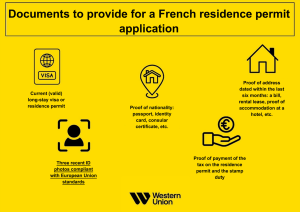
When applying for a residence permit in France, you must provide several mandatory documents that vary according to the permit applied for and your personal or professional situation. You must provide the originals and copies of the required documents, and, if applicable, have them translated into French by a certified translator-interpreter.
The list of documents to be provided is indicated when you apply. In general, any application for a French residence permit must include:
- 3 recent passport photos complying with European Union standards.
- A valid long-stay visa or residence permit.
- Proof of nationality: passport (pages relating to civil status, validity dates, entry stamps and visas). Otherwise, another piece of evidence, such as a consular certificate, an identity card, etc.
- Proof of address dated less than 6 months: bill (electricity, gas, water, landline, internet), rental lease of less than 3 months or rent receipt (if tenant) or housing tax (if owner), certificate of hotel accommodation and invoice for the last month, certificate of accommodation in a private home dated and signed with a copy of the host’s identity card.
- Proof of payment of the tax on the residence permit and stamp duty to be submitted at the time of delivery of the permit.
As an indication, for an application for a temporary residence permit “private and family life” residence permit as the spouse of a French national, you must also provide:
- Proof of civil status: a full copy of the birth certificate (unless you already hold a residence permit) with the most recent information, or a residence permit of the family member you have joined (except for a family member of a French national).
- A sworn statement that you are not living in France in a state of polygamy (if you are a national of a state that allows polygamy).
- Proof of marriage: full copy of the marriage certificate (in the case of a marriage celebrated abroad, transcription of the marriage in the French civil registers).
- Proof of your spouse’s French nationality: valid passport, valid national identity card or certificate of French nationality less than 6 months old.
- Proof of cohabitation: joint declaration of honour by the couple attesting to your cohabitation and all documents establishing cohabitation (lease contract, EDF receipt, bank statement, etc.).
- A medical certificate issued by the OFII to be submitted at the time of the issuance of the residence permit.
Please note that any incomplete application may result in a refusal to obtain the requested residence permit.
What is the price of a residence permit in France
The price of a residence permit is generally €225, which includes a stamp duty of €25 and a tax of €200. These fees are to be paid by tax stamps, purchased online or in a tobacconist’s shop. You will need to provide proof of payment when you issue your residence permit.
The residence permit fee may be lower in some cases, such as when applying for a “seasonal worker” or “student mobility program” residence permit, which costs €75, or when applying for a “retiree” or “retiree’s spouse” residence permit, which costs €25.
Conversely, depending on the residence permit, you may have to pay an additional fee. Like what:
- If you apply for a temporary “private and family life” residence permit for the family of a foreigner legally residing in France, you must pay a private and family life fee of €225 and a regularisation visa of €200.
- For a young foreigner born in France or entering France as a minor, you must pay child welfare for the first application of €25.
How long does it take to process an application for a residence permit?
The processing time for an application for a residence permit in France can take between 3 and 9 months, depending on the type of residence permit applied for and the Prefecture of the place of submission. This period generally runs from the day your application is received by the Prefecture.
To avoid additional processing times and to obtain your residence permit quickly, make sure you submit a complete and well-organized file.
How do I renew a residence permit?
To renew your residence permit, you must apply for a residence permit 4 to 2 months before the expiry of your current residence permit. The renewal process is carried out exclusively on the ANEF platform, and costs around €225.
Have you obtained a residence permit and are looking for the best way to send money to another country? Western Union offers you the fastest, most reliable way to send and receive money. Take advantage of the best rates on the market in more than 200 countries.
FAQs
How long is a residence permit valid for in France?
The validity period of a residence permit in France can range from 1 to 10 years, depending on the permit obtained. For example, a temporary residence permit for “private and family life” can be valid for a maximum of 4 years, a residence permit for “ICT intern” is valid for 1 year, and a residence permit is valid for 10 years.
What residence permits allow you to work in France?
There are several residence permits that allow you to work in France, such as:
- The “private and family life” residence permit
- The “employee” or “temporary worker” residence permit
- The “Talent Passport” residence permit
- The “seasonal worker” residence permit
- The “ICT posted employee” residence permit
- The 10-year resident card
- The residence permit – Job search/business creation
Can you vote with a residence permit?
No, the residence permit does not allow you to vote in municipal and European elections in France. To be able to vote, you must be a French citizen or a citizen of the European Union residing on French territory. However, you can participate in professional and trade union elections.
Can you change the category of residence permit once in France?
Yes, it is sometimes possible to change the category of residence permit once you are in France. You can, for example, switch from a student residence permit to a worker’s residence permit. However, you must comply with the conditions and procedures specific to your situation.
Can you lose your residence permit?
Yes, you can lose your residence permit if it is not renewed or withdrawn. The withdrawal of the residence permit can occur for several reasons: expulsion decision, judicial decision of exclusion from the territory, threat to public order, state of polygamy, absence from French territory for more than 3 consecutive years, etc.
Disclaimer: This article has been written for general information purposes and does not constitute legal or professional advice from Western Union. This article is not intended to replace the advice of an administrative advisor or any other qualified professional.



